


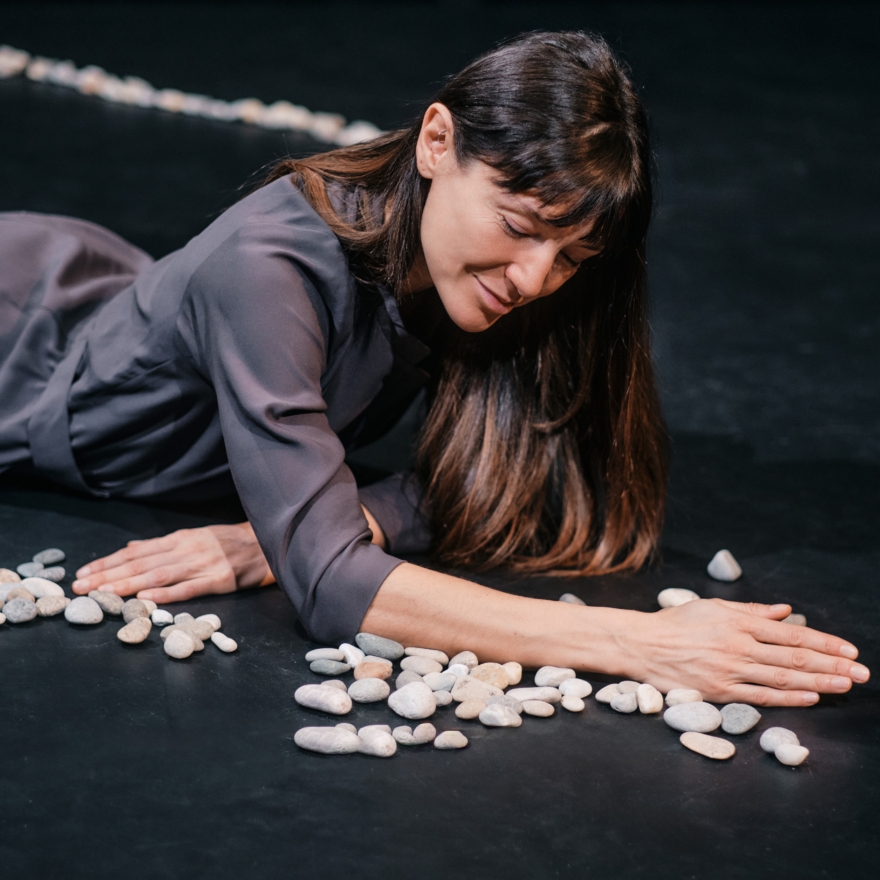
A talk with Kim Ceysens, choreographic development and performance for “Sanfte Steine”.
Kim Ceysens is a dancer, actress, and choreographer. Trained at RITCS in Brussels and at contemporary dance centres across Europe, including SEAD, she moves effortlessly between stage, film, and teaching.
At Toihaus, she has performed in “Blinds”, “Flausch”, “Nebelweich”, and “Ton”, and contributed to the creation of “Sanfte Steine”, in which she also performs. In our conversation, we spoke about working at Toihaus, the creative process behind “Sanfte Steine”, and rehearsing with the new material of stones.
You have already performed here several times. What does working at Toihaus mean to you?
Kim: For me, working at Toihaus feels like being part of a very familiar and warm environment. It’s a small artistic team, mostly female, which creates a very special atmosphere. What I appreciate is that each production begins with a very clear proposal. We discover the piece together during rehearsals, and that’s quite different from how I usually work.
Compared to the other productions, how was the creation of “Sanfte Steine” for you?
Kim: This is the third creation I’ve done for Toihaus, and this time I came in with certain expectations. Interestingly, those expectations shifted during the process. Initially, I thought “Sanfte Steine” might be closer to “Flausch”, but in the end they feel quite different. “Sanfte Steine” seems much purer to me — it focuses more on the material itself and is less theatrical. In “Flausch”, the emphasis was much more on performance and storytelling.
How was it for you to rehearse, experiment, and play with stones compared to the other materials you have worked with at Toihaus?
Kim: In a way, this feels like the first time I truly encountered a material. In “Flausch”, the fluff very quickly became almost like a character on its own. The stones, however, were full of surprises and stories from the very beginning. Sometimes I found myself bursting out laughing simply from watching how they roll or how they land.
So can stones be soft?
Kim: I think stones can be handled with softness and moved in very gentle ways. That’s really the key. Because they can also hurt if you sit on one the wrong way, for example.
What obstacles or surprises did you encounter during rehearsals?
Kim: The biggest surprises came from the stones themselves — their beauty and the way they move. The real obstacles are usually the humans: making decisions, navigating the creative process, and sometimes getting stuck along the way.
What role does the music play in “Sanfte Steine”?
Kim:The music is closely connected to the stones. It brings the piece together, creates connections, and adds an important emotional layer.
What can the audience expect from “Sanfte Steine”?
Kim: The piece invites the audience to look again at something very simple that many of us were fascinated by as children. When you went for a walk as a child, you often collected stones. As adults, we see them every day but rarely pay attention to them anymore. This piece creates an opportunity to rediscover their beauty, their movement, and even their musicality. There is also a subtle reference to Japanese gardening. “Sanfte Steine” becomes a journey exploring how stones move, fall, and roll.
How would you describe the piece in one word?
Kim: Balancing.